
Written by Paige Fowler, 05/15/2026
Finance teams are being asked to move faster than ever.
Business conditions shift constantly. Leadership wants quicker decisions. Departments are moving faster. And now AI is accelerating the speed and complexity of planning conversations even further.
In theory, this should elevate FP&A into a more strategic role.
In practice, many midmarket finance teams are struggling just to keep forecasts aligned.
The problem is not a lack of effort. Most finance teams are working harder than ever. The real issue is that many organizations are still relying on disconnected spreadsheets, manual reconciliations, inconsistent assumptions, and planning processes that cannot keep pace with the business.
And AI may be exposing those weaknesses even more.
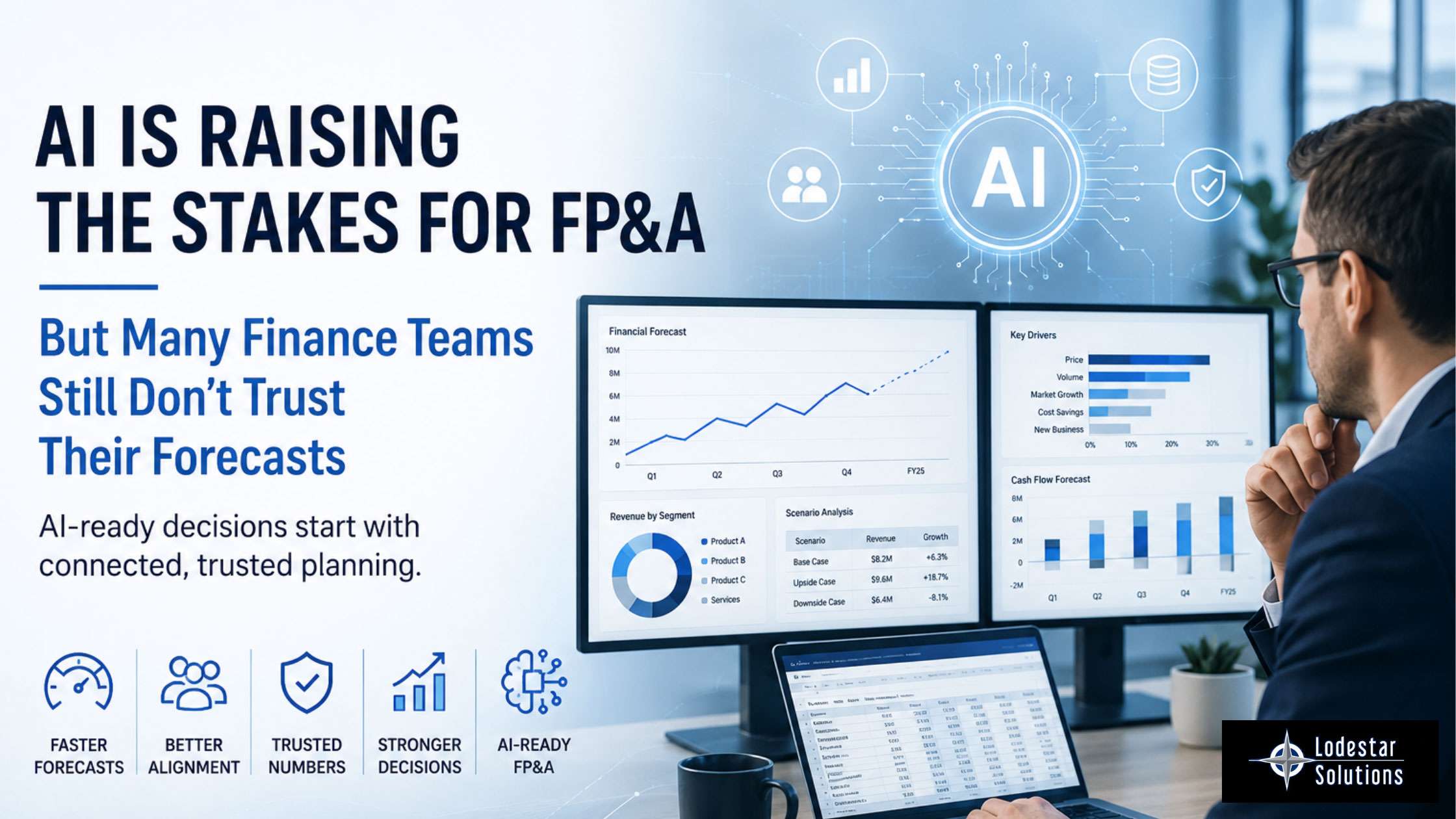
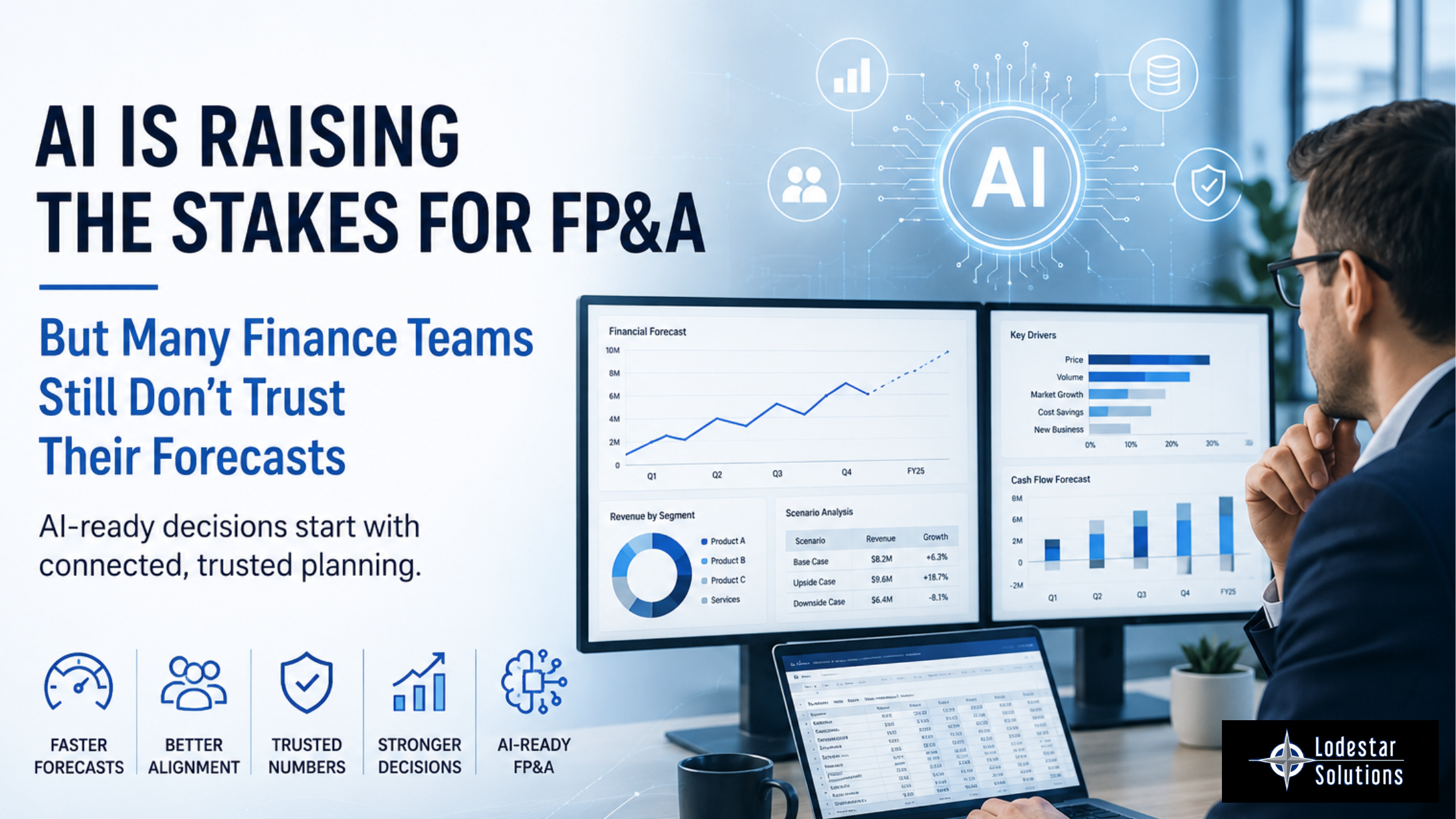
Faster Decisions Require More Trusted Planning
As organizations push toward AI-enabled decision-making, finance is expected to provide:
- Faster forecasts
- Better scenario modeling
- More cross-functional alignment
- Clearer financial guidance
- Greater confidence in the numbers
But those outcomes depend on something many organizations still lack: a connected planning process.
When assumptions live in separate spreadsheets, departments operate on different versions of the truth, and ownership is unclear, forecasting becomes reactive instead of strategic.
Finance teams often spend more time:
- validating numbers,
- reconciling inconsistencies,
- rebuilding reports,
- and chasing down spreadsheet errors
than actually analyzing the business.
That creates friction at exactly the moment organizations need agility.
AI Cannot Fix Fragmented Planning
AI is creating enormous excitement across finance and FP&A. It can help teams analyze trends faster, summarize insights, evaluate drivers, and support scenario planning.
But AI cannot create trust where trust does not already exist.
If planning data is disconnected, assumptions are inconsistent, and workflows are fragmented, AI may simply help organizations produce unreliable answers faster.
That is why many finance leaders are beginning to realize that becoming “AI-ready” starts with fixing the planning foundation first.
Before organizations can fully capitalize on AI in FP&A, they need planning processes that are:
- connected,
- governed,
- scalable,
- and trusted across the business.
Spreadsheet Flexibility Is Still Important — But Spreadsheet Chaos Is Not
Most finance teams are not looking to completely replace Excel.
They want to keep the flexibility finance users rely on while reducing the operational risks that come with disconnected spreadsheets, manual reconciliations, and inconsistent planning assumptions.
The challenge is that spreadsheet-based planning often becomes difficult to scale as organizations grow more complex.
Over time, disconnected files, manual processes, and inconsistent logic create operational risk:
- Forecast cycles slow down
- Scenario planning becomes difficult
- Teams lose confidence in the numbers
- Executive alignment weakens
- Finance becomes reactive instead of proactive
This is where many FP&A teams find themselves today:
stuck between the flexibility they want and the control they need.
Modernizing Planning Without Forcing Finance to Abandon Excel
Many organizations are shifting toward more connected planning approaches that improve governance, alignment, and forecasting speed without disrupting how finance teams prefer to work.
Platforms like IBM Planning Analytics are increasingly part of that conversation because they allow organizations to create more scalable, connected planning processes while still enabling finance teams to work within familiar Excel-based workflows.
But the broader challenge extends beyond any single technology platform.
Finance leaders are ultimately trying to answer bigger questions:
- How do we improve trust in the numbers?
- How do we shorten forecast cycles?
- How do we align assumptions across departments?
- How do we prepare FP&A for AI-enabled decision-making?
- And how do we modernize planning without creating even more complexity?
These are the challenges many midmarket finance organizations are facing today.
FP&A Is Becoming Central to Business Execution
As decision cycles accelerate, finance teams are being asked to play a much larger role in guiding the business.
Leaders increasingly expect FP&A to:
- model scenarios quickly,
- quantify tradeoffs,
- validate assumptions,
- align departments,
- and communicate financial impact clearly.
That requires more than better spreadsheets.
It requires a planning environment that helps teams move faster without sacrificing trust in the numbers.
Organizations that modernize planning processes are often able to:
- reduce forecasting friction,
- improve collaboration,
- increase confidence in planning outputs,
- and respond more effectively to changing business conditions.
The challenge is figuring out how to modernize planning without disrupting the flexibility finance teams still rely on every day.
Upcoming Webinar: How Midmarket Finance Teams Are Modernizing Planning Without Abandoning Excel
To explore these challenges further, Lodestar Solutions — an IBM Gold Partner — is hosting an upcoming webinar:
How Midmarket Finance Teams Fix Slow Forecasts, Trust the Numbers, and Get AI-Ready Without Abandoning Excel
📅 Thursday, May 21
🕐 1:00 PM ET
📍 Virtual Event (Zoom) https://us02web.zoom.us/webinar/register/4017788553104/WN_WduzG7AHSXWvsnZqPcp-ow
🎓 1.0 CPE Credit Available
In this session, we will discuss:
- Why traditional spreadsheet planning is becoming harder to sustain
- How disconnected assumptions impact forecasting trust
- What finance teams are doing to improve planning alignment
- Why AI readiness depends on stronger planning foundations
- How organizations are modernizing planning while preserving Excel flexibility
- How connected planning platforms such as IBM Planning Analytics support more scalable, AI-ready FP&A processes
If your organization is struggling with slow forecasts, spreadsheet chaos, or growing pressure to become AI-ready, this webinar will provide valuable perspective on where FP&A is headed next.