
Last updated: June 2026
By Heather Cole, Lodestar Solutions
It is June. Budget season is closer than it feels.
Your AI initiatives may already be running. Microsoft Copilot licenses may be purchased department by department. AI pilots may be launching. Data teams may be experimenting. Consultants may already be involved.
But here is the question your board, CEO, or CFO will eventually ask:

“We approved money for AI. What did we get?”
If your FP&A model cannot answer that question, your organization is not truly budgeting for AI. It is funding disconnected experiments.
Direct Answer: What Is AI Budgeting in FP&A?
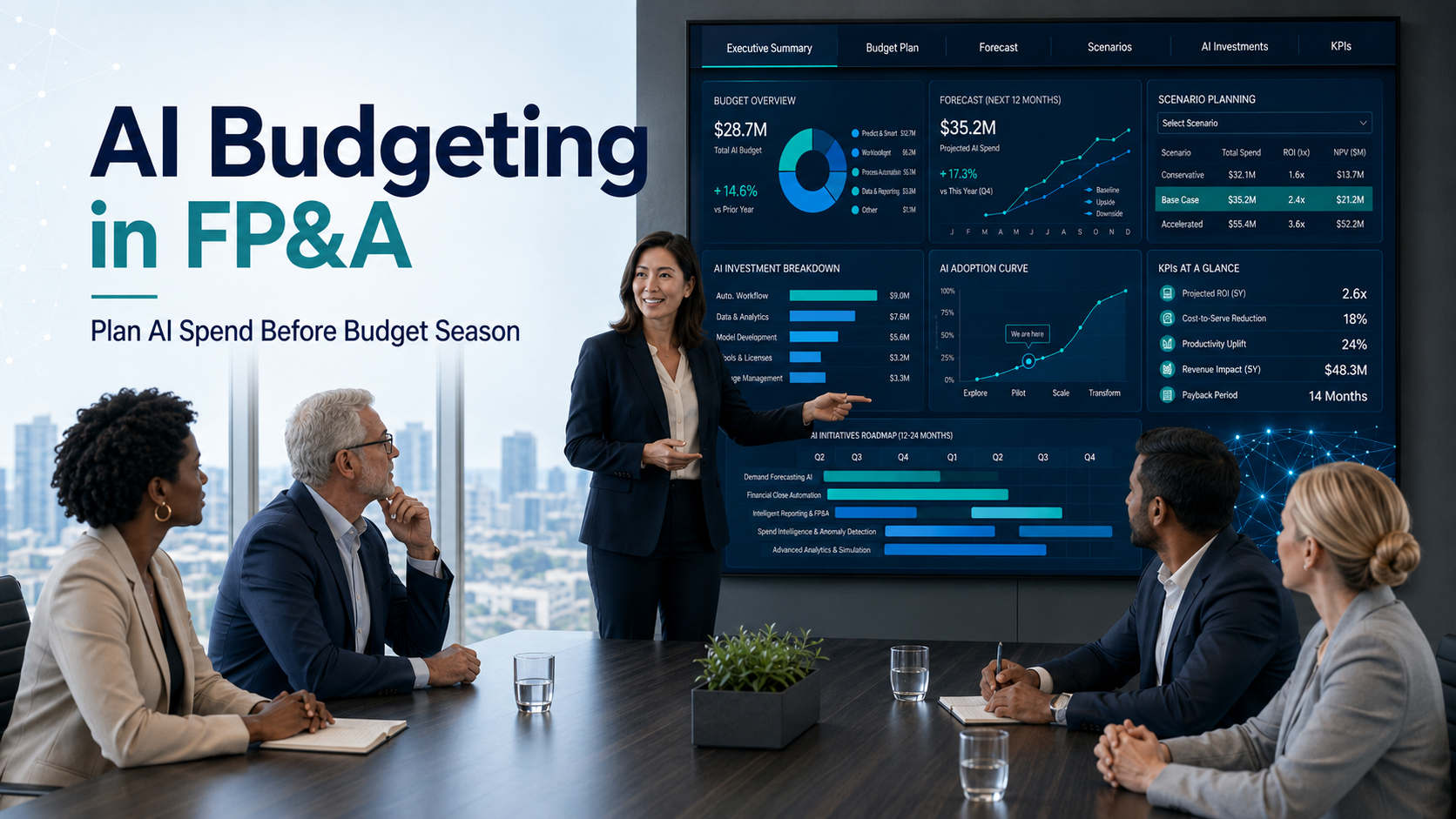
AI budgeting in FP&A is the process of modeling AI investments, costs, adoption assumptions, productivity impact, governance requirements, and ROI metrics inside the financial planning cycle. It helps finance leaders move AI from scattered departmental spend into a structured, scenario-based plan that can be reviewed, funded, measured, and defended.
That matters because AI costs do not behave like traditional software costs. They scale with usage, depend on data readiness, require governance, and often create a short-term productivity dip before measurable gains appear.
The companies that win with AI will not simply be the companies that spend the most. They will be the companies that model AI investment the best.
According to McKinsey Global Institute, generative AI has the potential to generate between $2.6 trillion and $4.4 trillion in annual global corporate value. But that value will not magically appear in the income statement. It must be planned, funded, adopted, measured, and governed.
Why AI Spend Is Becoming an FP&A Problem
Most organizations already have AI spend somewhere in the business.
The problem is that it is rarely visible in one place.
AI costs may be sitting across IT, operations, finance, sales, HR, data science, and department-level budgets. One team may be buying licenses. Another may be funding pilots. Another may be paying consultants. Another may be adding headcount. Another may be absorbing the cost of data cleanup.
Individually, each expense may look reasonable.
Collectively, they may represent a major strategic investment that no one is modeling as a portfolio.
That is where FP&A needs to step in.
AI should not be treated only as an IT project. It should be treated as an enterprise capability with financial assumptions, operational dependencies, adoption curves, risk factors, and measurable outcomes.
If your organization is already using or considering IBM Planning Analytics, this is exactly the kind of planning challenge where a connected model can outperform disconnected spreadsheets.
The Hidden AI Costs Most Budgets Miss
When finance teams budget for AI, they often start with the most visible cost: software.
That is understandable, but it is incomplete.
A serious AI investment model should include at least six categories.
1. Software and Platform Costs
This includes tools such as Microsoft Copilot, OpenAI, Anthropic, Google, IBM watsonx, analytics platforms, automation tools, and embedded AI features inside existing applications.
The planning risk is that AI usage often expands after initial approval. A pilot with 50 users may become a deployment with 500 users. A low-volume use case may become a high-volume workflow.
FP&A should model adoption ramps, usage tiers, and low, medium, and high consumption scenarios.
2. Data Preparation and Integration
AI depends on trusted, accessible, governed data.
Many organizations underestimate the cost of preparing data before AI can create real business value. That includes cleansing, integration, master data alignment, security, access controls, and documentation.
If data readiness is not funded, AI initiatives stall. Not because the technology failed, but because the business did not budget for the foundation.
3. Process Redesign
AI does not create value simply because a tool is available.
Value comes when workflows change.
That means teams need time to redesign processes, remove duplication, define new controls, and decide where human review is still required. These costs may not appear as vendor invoices, but they absolutely affect capacity and productivity.
4. Training and Change Management
AI adoption creates a learning curve.
Employees need to understand what the tools can do, where they should not be used, how outputs should be validated, and how AI fits into the way work actually gets done.
Budgeting only for licenses without budgeting for enablement is one of the fastest ways to create expensive shelfware.
5. Governance, Risk, and Compliance
AI introduces new questions around data privacy, model risk, auditability, disclosure, intellectual property, and decision rights.
Legal, finance, IT, security, and business leaders all need a governance model. That model has a cost.
If governance is not planned, it usually appears later as a delay, a compliance issue, or an emergency budget request.
6. ROI Measurement
If AI is approved as a strategic investment, it needs strategic measurement.
FP&A should define how AI value will be tracked before the money is spent.
Without measurement infrastructure, AI ROI becomes anecdotal. That is not enough for a board-level conversation.
Request an AI Budget Readiness Review
At Lodestar Solutions, we help finance teams use IBM Planning Analytics to build connected planning models that support budgeting, forecasting, scenario planning, and performance management.
If AI spend is already showing up across your business, now is the time to bring it into one planning model.
How FP&A Should Model AI Investment
The best AI budgets are not flat allocations. They are staged investment models.
A staged model helps executives see what must be funded now, what depends on adoption, and what outcomes should be expected over time.
Stage 1: Foundation
The foundation stage includes data readiness, integration, governance, tool selection, security review, and model design.
This stage may feel expensive because the business may not see immediate productivity gains. But it is the stage that determines whether AI can scale.
FP&A should model this stage separately so it does not get cut simply because it lacks short-term visibility.
Stage 2: Activation
The activation stage includes deployment, training, process redesign, change management, and early adoption.
This is where many AI plans become unrealistic.
A finance model should not assume immediate full adoption. It should model adoption curves.
Each scenario should show the effect on cost, capacity, productivity, and expected savings.
This is also where forecasting in IBM Planning Analytics with AI can be especially valuable. Instead of managing AI assumptions in disconnected spreadsheets, finance teams can build connected scenarios that link workforce plans, operating budgets, technology spend, and KPI dashboards.
Stage 3: Scale and Measure
The scale stage is where AI either proves value or becomes difficult to defend.
By this point, the organization should know which use cases are working, which are not, and where incremental investment makes sense.
FP&A should connect AI initiatives to financial outcomes such as margin improvement, operating leverage, revenue growth, working capital impact, or cost avoidance.
This is where the board conversation changes from:
“We are experimenting with AI.”
To:
“Here is what we funded, here is what changed, here is what we measured, and here is where we should invest next.”
The AI Budgeting Questions Every CFO Should Ask
Before finalizing the next budget cycle, finance leaders should ask:
- Where is AI spend currently sitting across the organization?
- Which AI initiatives are strategic, and which are experiments?
- What costs are missing from the current plan?
- What adoption assumptions are built into the forecast?
- What data, governance, and integration work must happen before AI can scale?
- What productivity dip or transition cost should we expect?
- Which KPIs will prove whether AI is working?
- Who owns the AI investment model?
- How will we report AI value to the board?
- What decisions need to be made before budget numbers are locked?
If your organization cannot answer these questions, the issue is not just an AI strategy problem. It is an FP&A problem.
Why June Is the Right Time to Start
For many organizations, June and July are when budget planning quietly begins.
Department templates go out. Leaders start building requests. Finance begins shaping assumptions. By September and October, the major conversations are already underway. By the time final approvals arrive, it may be too late to redesign the model.
That is why AI budgeting needs to start before the formal budget cycle is fully in motion.
If AI is going to be part of your strategy, it needs to be part of your financial plan now.
How IBM Planning Analytics Supports AI Budgeting
AI investment planning is exactly the kind of challenge where static spreadsheets start to break down.
You need scenarios. You need driver-based assumptions. You need version control. You need a way to connect workforce, operations, technology spend, and financial outcomes.
IBM Planning Analytics can help finance teams model:
- AI software and consumption costs
- Workforce and productivity assumptions
- Adoption curves by department
- Scenario comparisons
- Data and infrastructure investment
- Governance and compliance costs
- KPI dashboards tied to financial outcomes
IBM is also embedding more AI capabilities into Planning Analytics and Cognos, making it increasingly important for organizations to understand whether they are on versions that allow them to activate those capabilities.
At Lodestar Solutions, we help organizations use IBM Planning Analytics to bring structure, visibility, and accountability to planning processes that have become too complex for disconnected spreadsheets.
AI budgeting is one of those processes.
Final Thought
AI investment without an FP&A model is not a strategy.
It is a collection of hopeful experiments spread across the income statement.
The organizations that create real value from AI will not be the ones that approve the biggest budget. They will be the ones that understand the assumptions behind the budget, track the outcomes, and adjust the plan as reality changes.
Before budget season locks your numbers, ask one question:
Is AI actually in your financial plan, or is it just hiding inside everyone else’s budget?
Ready to Build a Real AI Budget Model?
If your organization is investing in AI and needs a better way to model cost, adoption, scenarios, and ROI, Lodestar Solutions can help.
We work with finance teams to build connected planning models in IBM Planning Analytics so executives can make better decisions with better numbers.
Email support@lodestarsolutions.com to request an AI Budget Readiness Review.
No obligation. We respond within one business day.
Frequently Asked Questions About AI Budgeting in FP&A
What is AI budgeting in FP&A?
AI budgeting in FP&A is the process of planning, forecasting, and measuring AI-related investments inside the financial planning cycle. It includes software costs, data readiness, adoption assumptions, productivity impact, governance, and ROI tracking.
Why should AI spend be included in the FP&A model?
AI spend should be included in the FP&A model because AI affects operating costs, workforce productivity, technology investment, risk, and long-term business performance. If it is not modeled, leaders cannot accurately evaluate cost or ROI.
What AI costs do companies usually miss?
Companies often miss data preparation, integration, training, change management, governance, compliance, process redesign, and ROI measurement costs. These costs can be larger than the initial software or license investment.
How can FP&A measure AI ROI?
FP&A can measure AI ROI by linking AI initiatives to specific business outcomes such as productivity per FTE, cost per transaction, forecast accuracy, reporting cycle time, revenue conversion, margin improvement, or reduced manual work.
How does IBM Planning Analytics help with AI budgeting?
Analytics helps finance teams build driver-based, scenario-based models for AI investment. It can connect AI spend to workforce plans, operational budgets, adoption assumptions, and KPI dashboards.
Sources
McKinsey Global Institute: AI could increase corporate profits by $4.4 trillion a year
Lodestar Solutions: IBM Planning Analytics, A Solution for Companies of All Sizes
Rolling Forecasts with IBM Planning Analytics.