Written by Paige Fowler, 01/08/2026
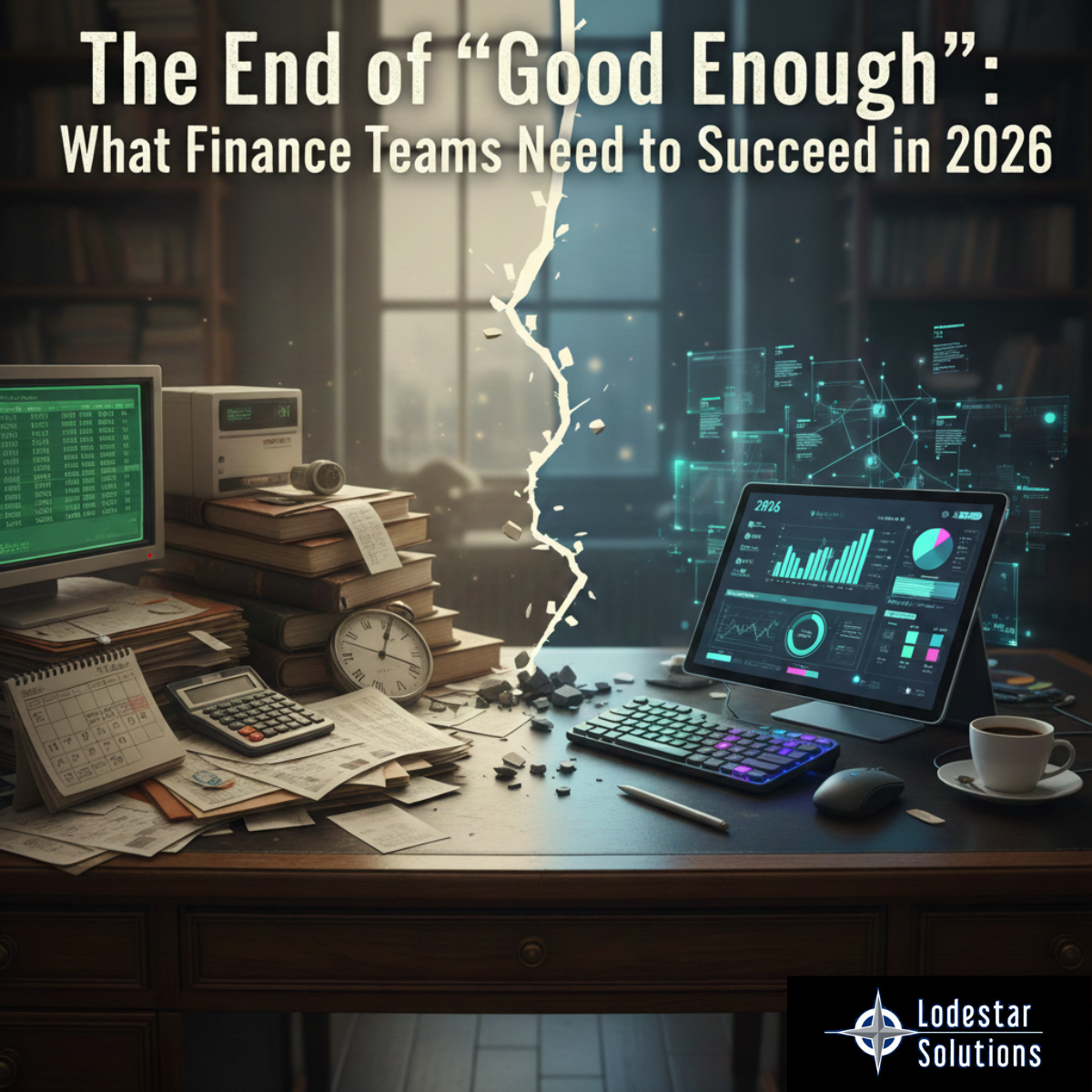
For a long time, “good enough” worked in finance.
Budgets were built annually. Forecasts were refreshed quarterly. Reports arrived after the close – accurate, reliable, and often too late to change the outcome. Leadership understood the limitations, and finance teams did the best they could with the tools they had.
That version of finance didn’t fail.
It simply ran out of runway.
As organizations enter 2026, the gap between finance teams that are merely functional and those that are truly effective is widening…fast.
Good Enough Was Built for a Different Era
Most finance teams didn’t wake up one day behind the curve. What exists today is the result of years of incremental process additions:
- Spreadsheet-based models layered on top of each other
- Manual data consolidation across departments
- Planning cycles that assume relative stability
None of this indicates poor leadership or lack of expertise. In fact, many finance teams operating this way are staffed by highly capable professionals.
But systems designed for predictability don’t perform well in constant change.
What Changed Without a Big Announcement
There was no single breaking point. Instead, three shifts quietly reshaped expectations:
- Volatility became permanent
Economic swings, labor pressures, supply chain disruption, and market uncertainty are no longer exceptions — they’re the baseline. - Decision velocity increased
Executives no longer have weeks to react. They expect scenario-based answers quickly, often before a formal forecast cycle completes. - Technology matured
AI, automation, and advanced planning capabilities moved from experimental to embedded — raising the bar for what’s possible.
According to McKinsey, organizations struggle when execution systems fail to keep pace with strategy, even when leadership direction is clear.
https://www.mckinsey.com/capabilities/strategy-and-corporate-finance/our-insights/closing-the-strategy-to-performance-gap
The result? Finance teams aren’t judged on effort anymore — they’re judged on responsiveness and insight.
The Hidden Cost of Standing Still
“Good enough” doesn’t usually trigger alarms. It shows up quietly as:
- Forecasts that are technically correct, but outdated
- Scenario questions that take days to answer
- Leadership decisions made without full visibility
- Finance teams stretched thin by manual work
Over time, this creates tension. Not because finance isn’t trusted — but because the organization needs more than the current model can deliver.
And the cost compounds:
- Slower decisions
- Missed opportunities
- Burnout among high-performing finance talent
What High-Performing Finance Teams Are Doing Instead
The teams pulling ahead aren’t chasing trends. They’re making intentional shifts in how planning and analysis happen:
- Moving from static annual budgets to rolling, driver-based forecasts
- Using scenario modeling proactively — not just during crises
- Automating data preparation and consolidation
- Applying AI to highlight patterns, risks, and key drivers
These teams still value governance, accuracy, and accountability. They’ve simply modernized the mechanism that delivers insight.
Platforms like IBM Planning Analytics support this evolution by combining forecasting, scenario planning, analytics, and AI within a controlled, auditable environment.
https://www.ibm.com/products/planning-analytics
This isn’t about replacing judgment. It’s about giving finance professionals better leverage.
What Moving Beyond “Good Enough” Looks Like in Practice
For many finance teams, the challenge isn’t knowing what needs to change — it’s figuring out where to start without disrupting what already works.
That’s exactly why we created the webinar Align 2026: How High-Performing Executives Set the Stage for Exponential Growth
Throughout January and February, Lodestar Solutions is hosting Align 2026 sessions weekly, designed specifically for finance leaders who want to:
- Pressure-test their current planning and forecasting approach
- Understand what modern finance looks like in practice — not theory
- See how rolling forecasts, scenario planning, and AI are being used responsibly
- Leave with clarity on what actually matters in 2026 (and what doesn’t)
These sessions are not product demos. They are practical, focused conversations built to help finance teams move beyond “good enough” toward planning models that support faster, more confident decisions.
👉 https://us02web.zoom.us/webinar/register/WN_arVrDKFJRsa_DEDac80SIw#/registration
Whether your organization is early in its modernization journey or already using advanced planning tools, Align 2026 offers a clear, realistic lens into how finance teams are evolving right now.
A Simple Reality Check
Consider this question:
If leadership asked for a downside scenario today, how quickly could your team respond — with confidence?
If the answer depends on manual work, offline models, or reconciliation across multiple files, the challenge isn’t people or priorities.
It’s the system.
Moving Forward
At Lodestar Solutions, we work with finance teams who are ready to move beyond functional planning toward models that support faster, better decisions without sacrificing control or credibility.
Book a FREE strategy call with us here
The goal isn’t transformation for transformation’s sake.
It’s ensuring finance has the tools to lead, not just report, in the year ahead.
Because in 2026, “good enough” isn’t a comfort zone. It’s a constraint.